
Analysis · Sport & power
Why Is the World Cup No Longer Just Football?
How the World Cup became a geopolitical instrument: Qatar 2022, Saudi Arabia 2034, FIFA’s neutrality, the 2026 North American tournament and Türkiye.
 6 July 202610 min read
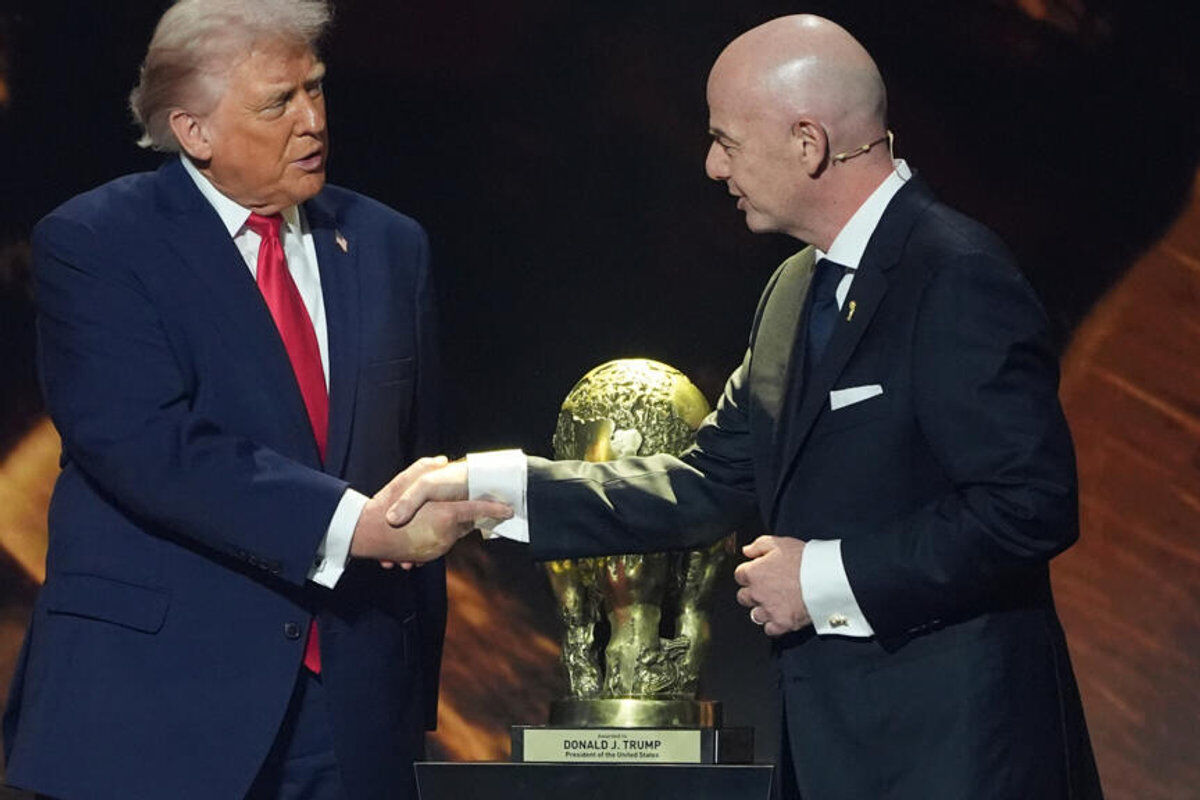
In today’s international system, the World Cup can no longer be seen merely as a sporting event. For states, the tournament has become a major geopolitical instrument of image-making, economic diversification, tourism strategy, diplomatic visibility, security architecture and the pursuit of global legitimacy. This article examines the World Cup from the perspective of international relations and sports diplomacy. Drawing on Joseph Nye’s concepts of hard power, soft power and smart power, it analyses Qatar 2022, Saudi Arabia 2034, FIFA’s claim to neutrality, the 2026 North American World Cup and the strategic use of sport from Türkiye’s standpoint. The central argument is this: although the World Cup remains a football tournament played on the pitch, behind the scenes it has become one of the ways in which states produce power, capital, prestige and security.
Looking at the World Cup from the System, Not the Pitch
When watching the World Cup, most people naturally focus on the pitch: the shirt, the anthem, the flag, the goal, victory and defeat. But the tournament’s meaning within the international system cannot be explained by on-field performance alone. The World Cup must also be read in terms of how states present themselves to the world, what image they seek to project, how they try to attract capital and how they strengthen their global diplomatic standing.
The use of the 1934 World Cup as a showcase for Mussolini’s regime in Italy, or the way the 1978 World Cup in Argentina became a means for the military junta to project the image of a “normalised and strong country” to the outside world, shows that the political function of sport is nothing new. What is new is that this relationship has today acquired a far more complex, commercialised and globalised structure.
Today the World Cup is part of a vast network linking FIFA, states, sponsors, broadcasters, security institutions, the tourism sector and global capital. To understand the tournament, therefore, one must look not only at who scored the goals, but at who built the stadium, who controls the broadcasting rights, what diplomatic message the host country is sending and which actors profit from the event.
Hence the fundamental question: is the World Cup still just a football tournament, or has it become a stage on which geopolitics, diplomacy and economic competition are continued by other means?
Soft Power: Where Does Football’s Geopolitical Power Come From?
According to Joseph Nye, power cannot be explained solely by military capacity, economic sanctions or the ability to coerce. States can influence other actors by compelling them, but they can also do so by generating attraction. This second form is soft power. Whereas hard power is concerned with the instruments of military, economic and political coercion, soft power produces influence through culture, values, media, education, the arts and sport. Smart power, in turn, is the combined and strategic use of these two forms of power.
Football is one of the most effective instruments of soft power. There are several reasons for this.
First, football is a universal language. People of different ideologies, cultures and classes can share a common emotional experience through football. Second, football converts rational political messages into emotional symbols. The flag, the anthem, the shirt, the goal, victory, defeat and the desire for revenge tie abstract state narratives to concrete emotions. Third, football generates enormous media visibility. Millions of people will never read a foreign policy document; but billions can watch a World Cup final. For states, this is an unrivalled opportunity for public diplomacy.
The literature on sports diplomacy shows that mega sporting events are, for states, not merely a means of generating economic revenue but also a mechanism for producing international prestige, brand value and public perception. Being perceived favourably matters for tourism, trade, foreign investment and diplomatic influence. The important point here is this: soft power is not simply about “looking good”. A deeper mechanism is at work. First, attention is captured. Then perception is shaped. Then behaviour is changed. If, after a World Cup, more tourists come to the host country, more companies see the prospect of investment, the media talk about that country more and the state becomes more visible diplomatically, then football ceases to be merely a sport. It becomes a geopolitical
instrument.
The World Cup Is a Display of State Capacity
Hosting a World Cup does not simply mean building stadiums. The event requires airport capacity, urban transport, security planning, hotel infrastructure, tourism management, broadcasting technology, crisis management and international coordination.
The World Cup is therefore a display of state capacity. The host country tries to send the following message to the world: “I am organised. I am secure. I am modern. I am fit for capital. I am attractive to tourists. I am an actor to be reckoned with diplomatically.”
This message is addressed not only to peoples, but to investors, international institutions, media organisations, sponsoring companies and other states.
The World Cup is thus a kind of demonstration of state capacity. The state targets not only football fans, but also investors, media organisations, international institutions and foreign publics. This matters especially for developing countries or those seeking greater visibility in the global system. Such countries use sport to try to secure a higher position in the global hierarchy. China’s use of the 2008 Beijing Olympics as a showcase of modernisation and state capacity, Qatar’s transformation of the 2022 World Cup into a strategy of global visibility, and Saudi Arabia’s linking of the 2034 World Cup to its post-oil transformation project should all be read in this light.
The meaning of the World Cup therefore extends well beyond ticket sales or tourism revenues. The real issue is where a country stands on the global map of perception.
Qatar 2022: A Security Strategy Beyond Sportswashing
The case of Qatar is one of the most important examples of why the World Cup cannot be explained by the concept of “sportswashing” alone. Qatar 2022 was, of course, the target of serious criticism over workers’ rights, human rights and migrant labour. But to treat the matter purely as image-laundering would be to ignore Qatar’s security architecture and regional vulnerability.
Qatar is a very wealthy country; but it is also a state with a small population, little territorial depth and a military capacity that is fragile compared with its regional rivals. Its position among powerful actors such as Saudi Arabia, Iran and the United Arab Emirates makes Qatar’s security problem a permanent one. Its energy resources give it enormous financial power; but in international relations, money alone does not produce security.
The blockade imposed on Qatar in 2017 by Saudi Arabia, the United Arab Emirates, Bahrain and Egypt exposed this vulnerability starkly. The blockade was not merely a diplomatic crisis but an instrument of pressure on Qatar’s position in the regional system. During this period Qatar sought to embed itself more deeply in the global system through Al Jazeera, its international media network, foreign investments, sports investments and security partnerships. The food supplies that Türkiye and Iran provided to Qatar during the blockade, and the strategic support Türkiye gave Doha through its military presence, showed that the crisis was not merely an intra-Gulf affair.
Qatar’s sports diplomacy must be read in this context. The investment in PSG, the beIN Sports network, international sporting events and, ultimately, the 2022 World Cup are all instruments that increase Qatar’s visibility. Yet this visibility serves not only to generate prestige but also to raise the cost of threatening its security. The more visible a country becomes and the more integrated it is into global networks, the higher the cost of any political or military move against it.
Qatar 2022 was therefore not merely a football tournament, but a small state’s strategy for making itself an indispensable and visible part of the global system. Here soft power merges with hard power. The US base at Al Udeid, military relations with Türkiye, the Rafale fighter jets purchased from France and the ties forged with the Western security architecture show that Qatar’s sports strategy is in fact a smart power strategy.
Saudi Arabia 2034: The Football Showcase of the Post-Oil Era
Saudi Arabia’s forthcoming hosting of the 2034 World Cup has further reinforced football’s central place in Gulf geopolitics. For Riyadh, football is not merely a question of image. It is one of the most visible faces that the Vision 2030 project presents to the outside world.
The basic logic of Vision 2030 is to wean the Saudi economy off its dependence on oil revenues and to develop tourism, entertainment, finance, technology and the service sectors. In this transformation, football is extremely useful in terms of the attention economy. Football offers a unique platform for capturing the interest of global public opinion, building a new national brand and presenting the country as an investable hub.
Saudi Arabia’s signing of star footballers in recent years, its investment in international sporting events and its cultivation of closer ties with global sports networks through the Public Investment Fund are all part of this strategy. The PIF’s emergence as one of the official tournament supporters of the 2026 World Cup also shows that Saudi sports diplomacy is deepening not only at the national level but within FIFA’s global networks as well.
Yet the Saudi case cannot be explained by outward-facing image politics alone. It is also a project for transforming society at home. Football, concerts, the entertainment industry, tourism projects and mega events offer the young population the promise of a new way of life.
But this transformation is not without risk. Saudi society is not homogeneous. Hidden tensions may arise between conservative religious structures, tribal balances, the expectations of the young and the top-down modernisation pursued by the state. Saudi Arabia 2034 will therefore be one of the sociological and geopolitical laboratories not only of football but of the post-oil era.
FIFA: Neutrality or Politicised Neutrality?
FIFA presents itself as an institution above politics, neutral and serving football alone. Yet studies of global sports governance show that international sporting bodies such as FIFA are not entirely independent of the balance of power. After Russia’s invasion of Ukraine, FIFA and UEFA banned the Russian national team and Russian clubs from international competitions. In the face of Israel’s cruelty, by contrast, FIFA took a far more cautious line. This discrepancy has called FIFA’s claim to neutrality into question.
To explain this simply in terms of “hypocrisy” is analytically inadequate. The more appropriate concept is “politicised neutrality”. This term describes a situation in which an institution maintains its claim to neutrality while its decisions are shaped by international pressure, sponsor relationships, the media environment, legal disputes and the positions of the great powers. FIFA’s swift and severe response on Russia is linked to the fact that the Western bloc adopted a largely united stance on that file. When it comes to the crimes against humanity, the massacres and the violations of international law committed by Israel, the global balance of power is different. The relationships between Western states, the Global South, Arab countries, human rights organisations and sponsor networks are far more complex.
FIFA is therefore not a technical body that acts solely according to the rules of football. Although it appears to be the referee of global football, it is in fact an actor positioned within the power relations of the international system.
The 2026 North American World Cup: Borders, Visas and the Politics of the Mega Event
The 2026 World Cup will be jointly hosted by the United States, Canada and Mexico. For the first time, the tournament will be organised by three countries and played in a new 48-team format. The increase in the number of matches to 104 enlarges the tournament’s scale not only in sporting terms but in logistical and political terms as well.
This expansion has several consequences. First, the World Cup is no longer confined to stadiums. Airports, urban transport, hotels, health systems, security institutions, border crossings and visa systems are all part of the event.
Second, the domestic politics of the host countries directly affect the running of the tournament. The security and immigration policies of the United States in particular will be among the most sensitive issues of the 2026 World Cup. The fact that FIFA does not guarantee ticket holders a visa or entry into the country shows how a sporting event can collide with border regimes. One of the most concrete examples of this was seen in the case of the Iranian national team. Although Iran played its 2026 World Cup matches on US soil, it was forced to base its team camp in the Mexican city of Tijuana rather than in the United States. The refusal of visas to the administrative and support staff of the Iranian delegation, and the fact that the team could enter the United States only for matches and for limited periods, showed how deeply sport is entangled with security policy. This example should be considered alongside the chronic tension in US–Iranian relations and the atmosphere of conflict and security concerns in early 2026. For what is at stake here is not simply a football team’s choice of training camp. Where a national team trains, which country it enters and when, who can obtain a visa and how the delegation is monitored all become direct matters of international security. The Iranian case thus shows that the 2026 World Cup brings onto the pitch not only footballers, but passports, border crossings, visa regimes and the security reflexes of states.
Third, the question of economic impact must be treated more carefully. Mega events are generally presented as an “economic opportunity”. A boost to tourism, hospitality, transport and retail is expected. Yet research stresses that such projections are often overly optimistic and can produce unequal outcomes between cities. The reason is that the revenues of mega events are often not distributed evenly among the local population. While the major profits are generally shared among FIFA, sponsors, hotel chains and large infrastructure companies, a significant portion of the spending on security, transport, infrastructure and public services is loaded onto the budgets of the host cities.
The 2026 World Cup will therefore be not only an expansion of football, but an important test of North America’s border management, security capacity, urban planning and global image-making.
What It Means for Türkiye
In Türkiye, football has never been merely football. Clubs, cities, neighbourhoods, classes, identities and political emotions have often become visible through football. The national team is one of the most intense forms of this feeling.
Third place at the 2002 World Cup was recorded in Türkiye’s collective memory as more than a sporting achievement. At a time when the country was struggling with economic and political crises, it became a symbolic moment in which Türkiye told the world: “we are here too”.
In today’s world, however, football’s meaning is broader. Football is no longer played only on the pitch. It is also played in club acquisitions, broadcasting rights, stadium investments, tourism strategies, diplomatic crises and the security architecture of states.
For Türkiye, the fundamental question is this: will Türkiye remain a society that merely consumes and argues about football, or will it be able to use sport more strategically as an instrument of soft power, public diplomacy, brand value, tourism and regional influence?
Türkiye’s geographical position makes this question all the more important. Situated at the intersection of Europe, the Middle East, the Caucasus, the Black Sea and the Mediterranean, Türkiye must think of sports diplomacy as one of its foreign policy tools.
The fact that EURO 2032 will be co-hosted by Türkiye and Italy is a significant opportunity in this respect. The event does not simply mean hosting matches. Türkiye’s infrastructure capacity, urban management, security planning, tourism strength, transport network and international image will all be put to the test in the process. The role Türkiye played, through Turkish contractors, in the infrastructure and stadium projects in Qatar is also significant. It shows that sports diplomacy operates not only through football federations or clubs, but through the construction, logistics, infrastructure and service sectors as well.
For Türkiye, then, the question is not “Does football matter?” That much is already clear. The real question is this: is Türkiye reading the new function of football in international relations strategically enough?
The Real Match Is Being Played on the Map
The World Cup is still football. But it is not only football.
The tournament is one of the ways in which states tell their story to the world. For Qatar it is a strategy of visibility and security. For Saudi Arabia it is a showcase for post-oil transformation. For FIFA it is an arena of global legitimacy and balance of power. For North America in 2026 it is a test of borders, security and economic capacity. For Türkiye it is an opportunity to rethink the geopolitical meaning of sport.
A glance at the calendar of World Cup hosts shows that it is not only football but the direction of the world that has changed: Russia 2018, Qatar 2022, North America 2026, the Morocco–Spain–Portugal partnership in 2030 and Saudi Arabia 2034. This picture points to a multipolar era in which the old Western-centred sporting order is no longer the sole arbiter, and in which Gulf capital, the Global South and rising powers are seeking new arenas of legitimacy.
If all we see on the screen is 22 players chasing a ball, then we are merely watching the game. But once we begin to look at who financed the stadium, who bought the broadcasting rights, who the sponsors are, which leaders sit side by side in the VIP box and what message the host country is sending to the world, we see that the real match is being played on the map. That is why the World Cup is part not only of the history of sport, but of the history of international relations.
Bibliography — Academic Articles and Scholarly Studies
- Çetin, Cem. (2022). “Uluslararası İlişkilerde Bir Kamu Diplomasisi Aracı Olarak Spor: ABD ve Katar Örnekleri.” [Sport as an Instrument of Public Diplomacy in International Relations: The Cases of the USA and Qatar]. Journal of Health and Sport Sciences (JHSS), 5(2), 35–46.
- Næss, Hans Erik. (2023). “A Figurational Approach to Soft Power and Sport Events: The Case of the FIFA World Cup Qatar 2022™.” Frontiers in Sports and Active Living, 5, Article 1142878.
- Ghifari, Muhammad F., & Nugroho, Bambang W. (2025). “Geopolitics and International Sports Governance: A Case Study of FIFA’s Response to the Russian and Israeli National Teams Amid Russia’s Versus Ukraine and Israel’s Versus Palestine Rage.” JRSSEM, 5(5), 9585–9599.
- Elias, Tarek. (2021). “Qatar’s Sports Diplomacy as a Driver for International Visibility, Prestige, and Branding.” Sciences Po Kuwait Program Student Paper Award. Sciences Po, Spring 2021.
- Brouard, François, & Movileanu, Adrian. (2026). 2026 Men’s FIFA World Cup: An Examination of a Major Event. Research Note #PARG 2026-72RN. Political Accounting Research Group, Sprott School of Business, Carleton University.
Books and Theoretical Sources
- Nye, Joseph S. (1990). “Soft Power.” Foreign Policy, 80, 153–171. This is the classic article on the concept of soft power.
- Nye, Joseph S. (2004). Soft Power: The Means to Success in World Politics. New York: PublicAffairs.
- Nye, Joseph S. (2011). The Future of Power. New York: PublicAffairs.
News and Current Sources
- Reuters. (2026, May 14). “PIF Named 2026 World Cup Official Tournament Supporter as Saudi Steps Up Football Ambitions.” Reuters.
- Reuters. (2026, June 30). “Iran Thank Tijuana After World Cup Exit, Support Mexico as ‘Second Team’.”
- The Guardian. (2026, June 30). “Iran Hit Out at ‘Lies and Mistreatment’ Following US Official’s Joy at Team’s Exit.” The Guardian.
Official Institutional Sources
- FIFA. (2024). FIFA World Cup 2030™ Bid Evaluation Report. Fédération Internationale de Football Association.
- FIFA. (2024). FIFA World Cup 2034™ Bid Evaluation Report. Fédération Internationale de Football Association.
- FIFA. (2024, December 11). “FIFA Confirms Hosts for 2030 and 2034 FIFA World Cup™ Editions.” Fédération Internationale de Football Association.
- UEFA. (2023, October 10). “UEFA EURO 2032 to Be Staged in Italy and Türkiye.” Union of European Football Associations.