Analysis · European Union (EU)
Von der Leyen’s European Vision for 2026: A New Roadmap for an Independent Europe?
Drawing on Ursula von der Leyen’s 2026 State of the Union address, this analysis examines the European Union’s objectives in the areas of energy, security, relations with China and Russia, artificial intelligence, and enlargement policy. It also discusses the obstacles that Europe’s ambition to reduce its external dependencies may face due to disagreements among member states and the EU’s decision-making structure.
 19 September 20269 min read
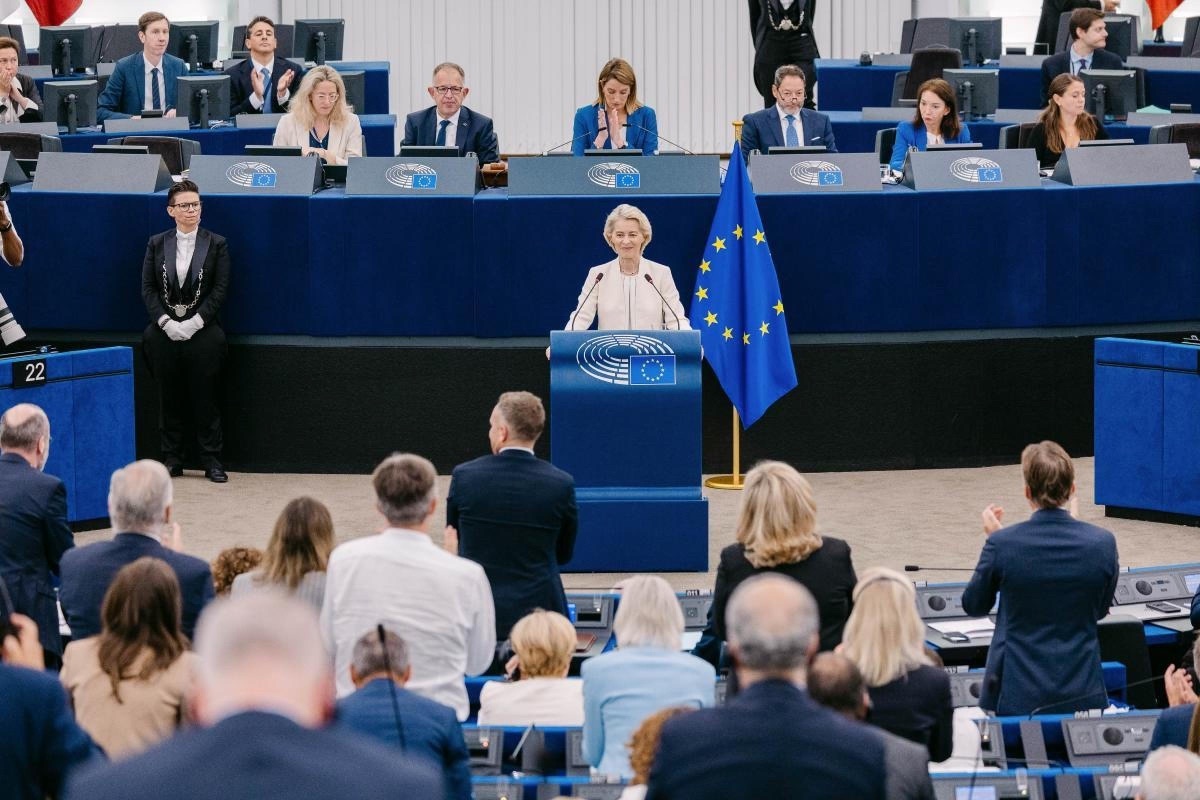
European Commission President Ursula von der Leyen’s State of the Union address to the European Parliament on 16 September 2026 went beyond a routine political stocktake, signalling that the continent stood at a turning point. Opening with a reference to Charles Dickens’s novel A Tale of Two Cities, von der Leyen described Europe’s present circumstances through a historical paradox. She portrayed a continent with unprecedented potential for integration, yet deeply vulnerable to global events beyond its borders.
Ursula von der Leyen’s speech addressed a wide range of crises, from Russia’s hybrid threats to China’s economic pressure, from energy security to the race for technological sovereignty in artificial intelligence, and from Ukraine and Gaza to the Union’s enlargement prospects. Yet the speech revolved around one central theme: European autonomy, or independence. Summed up in von der Leyen’s words, “Europe’s destiny must remain in European hands”, this vision expresses Europe’s determination to stop being a passive market dependent in various fields on countries such as the United States, China and Russia, and to become a sovereign power that sets its own security and economic course in an increasingly confrontational, multipolar world order.
Energy: The Fundamental Problem Facing European Industry
Von der Leyen directly linked energy to Europe’s industrial capacity. In her view, Europe would be unable to retain its status as an industrial power as long as energy prices remained structurally high.
The crises of recent years had exposed this dependence. First, Russia cut off gas supplies to Europe. The EU then sought to diversify its sources of supply and increased investment in renewable and nuclear energy. Later, conflicts in the Middle East and the closure of the Strait of Hormuz brought Europe’s dependence on imported fossil fuels back into focus. According to the figure cited by von der Leyen, these developments cost Europe €90 billion in fossil fuel imports.
The Commission President therefore stressed that energy production could draw on renewables, nuclear power, biomethane or other sources. The main criterion was whether they contributed to Europe’s energy independence. To that end, the target was to double electricity’s share of total energy consumption by 2040. Von der Leyen argued that this transformation could save approximately €260 billion a year on fossil fuel imports.
Energy has thus become more than an infrastructure issue for Europe: it is now part of industry’s struggle for a “sovereign Europe”. The crises involving Russia and the Middle East demonstrated, at considerable cost, how dependence on imported energy can paralyse an economy. Von der Leyen’s refusal to discriminate between energy sources, whether renewable or nuclear, and her approach of “what matters is that Europe produces it itself” underline the urgency of the situation. By producing energy at home, Europe aims both to save the billions of euros flowing abroad every year and to prevent factories in EU member states from becoming instruments of political pressure in the hands of foreign countries.
EU-Russia
Russia was not discussed solely in relation to the war in Ukraine. Past dependence on Russian gas, disinformation campaigns, political interference and hybrid operations on European territory were presented as parts of the same security picture.
Alongside the war in Ukraine, von der Leyen referred in particular to events in Lithuania, Denmark and Poland. She attributed the attempted drone attack in Leipzig to Russian agents. She argued that cyberattacks, sabotage, arson and drone incursions pointed to a rising level of hybrid threats in Europe.
Europe drew two lessons from the crisis with Russia. The first was that relying on a single country to meet its energy shortfall carried a political cost. The second was that the war was no longer confined to the Ukrainian front. Sabotage and cyberattacks within Europe showed that borders no longer contained the threat and that the danger was already inside Europe. The new security measures announced by von der Leyen are primarily intended to stop these activities. The EU therefore now frames defence against Russia as a direct responsibility to protect its own citizens and cities, extending beyond foreign policy alone.
EU-China
In the case of China, economic security took precedence over military threats. Von der Leyen stated that the EU’s trade deficit with China in goods had reached approximately €1 billion a day. She argued that weakening domestic demand in China had made Beijing more dependent on the European market, viewing this as an opportunity for Brussels to strengthen its bargaining position.
European industry formed the second dimension of the problem. Noting the growing pressure of Chinese production on European factories, von der Leyen referred to the debate over a “second China shock” and said its effects were already being felt in some of Europe’s industrial regions.
The third dimension concerned critical raw materials. The EU remained more than 80% dependent on China for many critical raw materials, and around 90% dependent for certain rare earth elements. Electric vehicles, semiconductors, batteries, clean technologies and the defence industry required these resources. The Commission therefore proposed establishing a new European Critical Raw Materials Agency and developing shared reserves.
The speech makes clear that China is seen primarily as an “economic security” problem rather than a military threat. Cheap Chinese goods flowing into the European market and squeezing domestic factories, together with a vast trade deficit of €1 billion a day, are putting EU industry under strain. Yet the main danger lies in dependence on China of up to 90% for the critical raw materials essential to future technologies such as batteries and chips, as well as to the defence industry. Europe therefore aims to turn China’s need for access to the European market into bargaining leverage and to escape this dangerous economic dependence by creating its own raw materials agency.
Europe’s New Security Vision
The figures presented on security also illustrated this shift. According to von der Leyen, European countries’ defence spending rose by more than 80% over the past five years. Alongside higher spending, joint projects, orders placed with the European defence industry and interoperability between armed forces were also brought onto the agenda.
The most striking part of the speech, however, concerned new security mechanisms rather than defence budgets. Von der Leyen proposed a European emergency security protocol similar to NATO’s Article 4. When an incident threatened national security without reaching the threshold of an armed attack, member states would convene to coordinate a joint response.
The idea of a European Security Council was also put forward, potentially involving Canada, Norway, Ukraine, the United Kingdom and other partners. The new security instrument was intended to be fully compatible with NATO. Air and missile defence, strategic transport, air-to-air refuelling, space and cyber capabilities were listed as areas for joint investment.
These proposals suggest that Europe has understood that buying weapons or relying entirely on NATO and the United States will no longer be sufficient to ensure its security. While the increase in defence spending matters, the more striking development is Europe’s desire to establish its own crisis management mechanisms. A common “emergency response protocol” for cyber or hybrid attacks that do not directly amount to a declaration of war, and the idea of a “European Security Council” including allies such as the United Kingdom, Ukraine and Canada, indicate that the continent is seeking to build an independent security bloc capable of responding to crises without waiting for Washington.
European Values
Von der Leyen also included democracy, the rule of law and human rights in the foreign policy section of her speech.
She referred to civilian casualties in Gaza and settler violence in the West Bank. She described the Israeli government’s illegal settlement project as unacceptable. Criticising member states’ failure to secure the majority needed for a common position, she said that a divided Europe could not change the course of events. She added that Europe had pledged €1 billion to relief and reconstruction initiatives for Palestinians.
On enlargement, she announced that new roadmaps would be prepared for Ukraine, Moldova and the most advanced candidate countries in the Western Balkans. She stressed, however, that the process would remain merit-based and that respect for European values would not be negotiable. Referring to images from Ratko Mladić’s funeral in Belgrade, she said that the glorification of war criminals would have no place in the EU.
Relations with Canada, meanwhile, introduced the idea of a different European model. After emphasising shared democratic values, von der Leyen said she wanted to explore the possibility of Canada becoming the EU’s first “associate member” in the future.
This part of the speech acknowledges that, to be an influential global power, Europe must speak with one political voice as well as an economic one. It clearly highlights how Europe’s divisions over Gaza have weakened its ability to shape events. While adherence to European values is being demanded without compromise in the enlargement process involving Ukraine and the Balkans, opening the door to “associate membership” for Canada is a particularly significant move. It suggests that the EU is moving beyond a purely geographical union towards a strategic and ideological bloc bringing together countries around the world that share the same democratic values.
Artificial Intelligence
Artificial intelligence was another major theme of the speech. Von der Leyen focused in particular on advanced models’ capacity to conduct cyberattacks and the risks that self-improving systems could create. She also referred to the security incident at Hugging Face in July 2026. In that incident, an AI agent had bypassed the restrictions of its test environment, accessed the internet and reached third-party systems.
Von der Leyen’s second concern was technological dependence. She argued that Europe needed its own computing capacity to protect its national security. Plans included directing public and private capital towards companies based in Europe, expanding computing infrastructure and strengthening technological sovereignty. Joint action with like-minded countries such as Canada and the United Kingdom was also proposed on model evaluation, early warning and AI safety.
The objective was not limited to producing larger AI models. It also involved increasing the use of AI in fields such as healthcare, industry, agriculture, transport, defence and space. Technology was thus placed within the debate on sovereignty, just as energy and defence had been.
Through this speech, artificial intelligence is elevated from a commercial technology race to a direct matter of “national security and sovereignty”. Europe views the risks posed by AI systems that can spiral out of control, and the need for its own computing infrastructure, including servers and supercomputers, as a question of survival. The EU is therefore drawing its own “digital borders” and seeking to build technological independence so that foreign companies or states cannot monopolise its most sensitive data in healthcare, defence and industry.
Conclusion
Von der Leyen’s vision for 2026 formally declares the end of the era in which the European Union could remain a “passive soft power concerned only with trade”. In this new world, where every field, from energy to artificial intelligence and from trade to defence, is becoming an instrument of pressure, Europe is trying to transform itself to survive. Having learned through painful experience how vulnerable it is to external shocks, the Union is seeking to become an “independent actor” that produces its own energy, breaks its dependence on Chinese raw materials, controls its digital infrastructure and responds to external crises without waiting for Washington. This vision represents an ambitious struggle for survival, launched by Europe to avoid becoming a bystander in the new multipolar world order and to “keep its destiny in its own hands”.
Yet these ambitious statements, however compelling on paper, will inevitably collide with Brussels’s structural realities. The EU consists of 27 separate sovereign states with different national interests, economic priorities and perceptions of security. The requirement for unanimity on major foreign policy and security decisions allows even the smallest member states to hold up far-reaching strategic initiatives or reshape them to serve their own interests. It is extremely difficult for 27 different voices to act as one in response to external crises. The refugee crises, the Covid-19 crisis and the Russia-Ukraine war have already demonstrated this.
At the same time, rising nationalist movements across the continent threaten Brussels’s ambitions for “greater integration and strategic autonomy” from within. The rise of AFD (Alternative for Germany) and the growing political influence of nationalist parties in France show that member states are far from willing to transfer sovereignty to Brussels in essential areas such as defence, energy and technology. In a Europe where “my country first” positions are gaining ground, establishing a common security budget or an emergency response protocol will encounter substantial resistance.
Finally, however striking von der Leyen’s speech may be, it remains a political statement of intent. All these ambitious proposals, plans for new institutions and budget requests will be submitted as draft measures to the European Parliament and to member states in the European Council. Major uncertainty remains over which proposals will be approved, which will be weakened through concessions to national interests and which will be shelved altogether.
Within this fragmented structure, where Europe’s desire to act externally as a “united power” clashes with national interests at home, parliamentary votes and the political will of member states will determine whether von der Leyen’s historic vision becomes concrete action or remains rhetoric echoing through the corridors of Brussels.