
Lens · SCO
President Recep Tayyip Erdoğan at the Shanghai Cooperation Organisation Summit in Tianjin
Erdoğan’s talks with Chinese, Russian, Iranian, Pakistani and Caucasian leaders at the Tianjin SCO Summit reveal Ankara’s diplomacy of balance.
 6 July 20263 min read
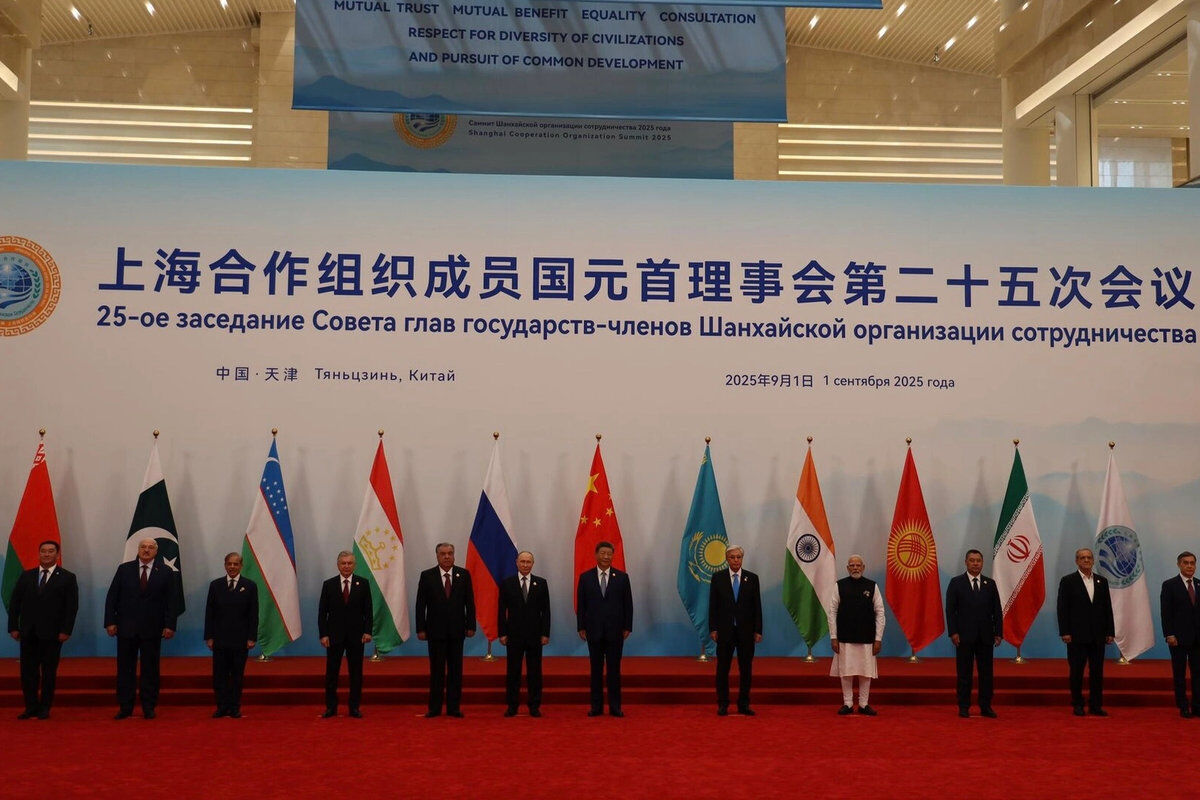
President Recep Tayyip Erdoğan’s participation in the 25th Summit of the Shanghai Cooperation Organisation, held in Tianjin on 31 August – 1 September 2025, demonstrated Ankara’s determination to strengthen its role in a multipolar world. On the sidelines of the summit, Erdoğan held a series of strategic bilateral meetings with the leaders of China, Russia, Iran and Pakistan, as well as with Azerbaijan and Armenia.
Dialogue with Beijing
Ahead of the summit, Erdoğan had published an article in the People’s Daily entitled “A Shared Path to Peace and Justice”, drawing attention to the importance of international solidarity under China’s leadership. Received by Chinese President Xi Jinping, Erdoğan called for more balanced trade, greater investment in new technologies, energy, health and tourism, and the alignment of the Middle Corridor with the Belt and Road Initiative.
Xi Jinping, for his part, described China and Türkiye as “emerging powers with a spirit of independence” and as actors of the Global South. The Chinese leader stressed that 2026, which marks the 55th anniversary of the establishment of diplomatic relations, should serve as an important opportunity to strengthen mutual trust and cooperation. He added that this cooperation should also encompass security and counter-terrorism. Xi further proposed expanding cooperation in renewable energy, 5G and biomedicine, and stepping up coordination in multilateral forums such as the United Nations, the G20, BRICS and the Shanghai Cooperation Organisation.
Erdoğan then met Cai Qi, First Secretary of the Secretariat of the Central Committee of the Chinese Communist Party. At this meeting he reiterated his determination to strengthen cooperation with Beijing not only at the bilateral level but also in multilateral forums. Erdoğan set out as a goal the balanced and sustainable growth of bilateral trade.
Moscow and the energy agenda
Talks with Russian President Vladimir Putin addressed regional crises and energy cooperation. Erdoğan raised in particular the question of financing for the Akkuyu Nuclear Power Plant, while Putin expressed his appreciation of Ankara’s mediating role in the war in Ukraine.
Regional dialogue with Iran and Pakistan
Erdoğan also met Iranian President Masoud Pezeshkian. The meeting reaffirmed cooperation in the energy sector and underscored Türkiye’s support for Iran’s nuclear negotiations. In his talks with Pakistani Prime Minister Shehbaz Sharif, cooperation in security and defence took centre stage. Erdoğan also criticised Israel’s policy in Gaza, noting that Ankara and Islamabad were of one mind on the issue.
The Caucasus at the heart of the talks
President Erdoğan also held talks with Azerbaijani President Ilham Aliyev and Armenian Prime Minister Nikol Pashinyan. Erdoğan welcomed the progress made in the Baku–Yerevan peace process and reaffirmed Ankara’s determination to contribute to the stability and development of the South Caucasus.
A multidimensional diplomacy
These contacts made Ankara’s strategy plain: to preserve its ties with its Western alliances while strengthening its relations with the East. Türkiye thus sought to position itself as a regional mediator, an energy partner and one of the influential actors of the Global South. Ankara championed the idea of a more multipolar and more equitable international order.
This approach also reflected Erdoğan’s determination to pursue a diplomacy of balance. Rather than confining itself to a single axis, Ankara chose to diversify its partnerships in line with its strategic interests. By engaging simultaneously with Beijing, Moscow, Tehran, Islamabad, Baku and Yerevan, Türkiye once again showed itself to be a middle power capable of talking to actors who are at times in direct confrontation with one another. This stance widened Türkiye’s room for diplomatic manoeuvre and strengthened its profile as a “pivotal state” amid the current geopolitical shifts.
Moreover, the emphasis placed on economic initiatives such as energy corridors, infrastructure projects and technological cooperation showed that Turkish diplomacy is not shaped by security concerns alone, but also rests on an inclusive vision of regional development. This multidimensionality has become one of the core elements of Türkiye’s strategy in a changing world order.
This article was first published in French on 19 September 2025 on Eurasiapeace. It was translated from the original into Turkish by Eren Gökdemir.